Monday, May 14, 2012

A Visit to Carrigaline and Environs

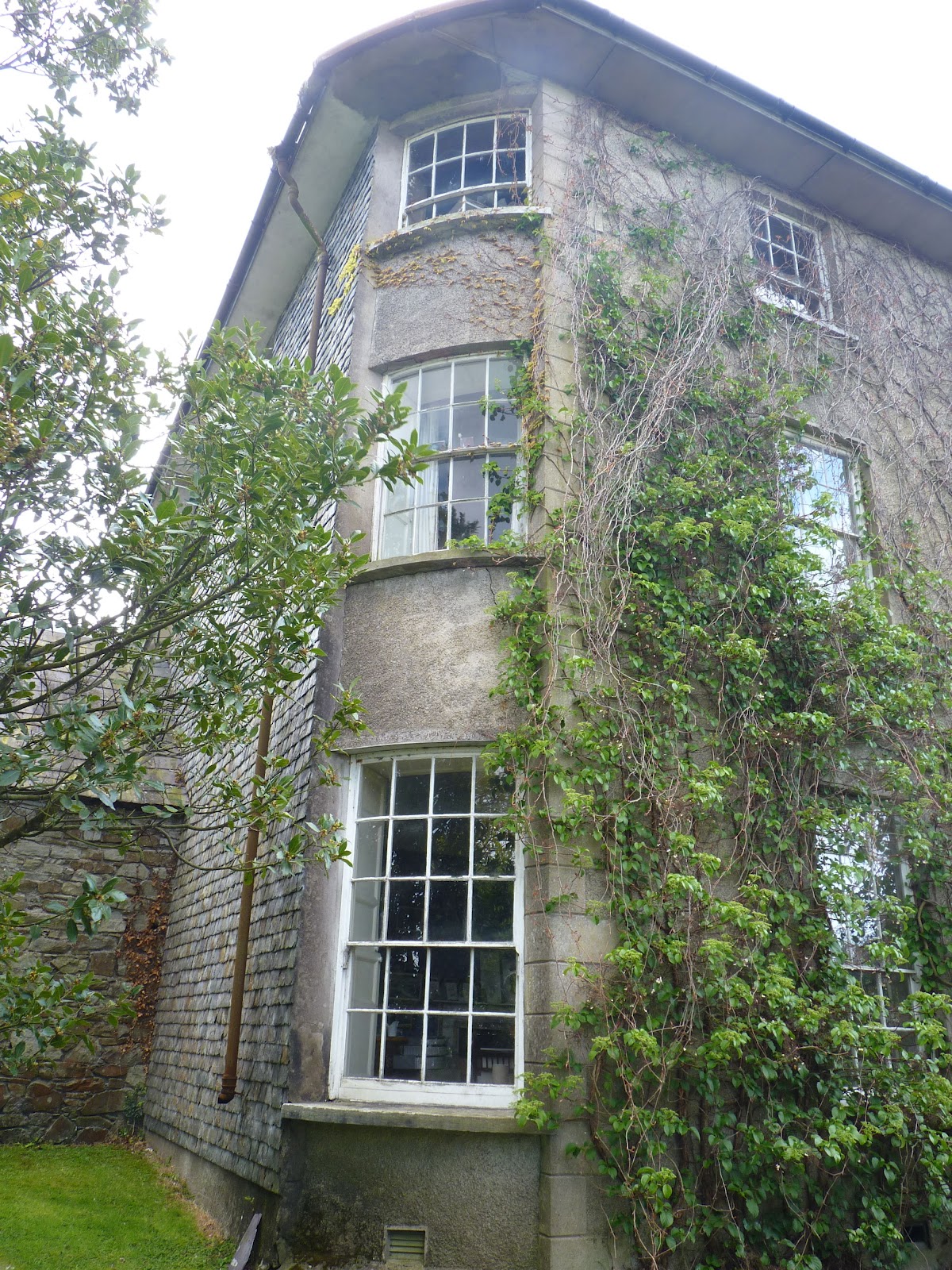


Some hidden jems within the environs of Carrigaline attracted an impressively large gathering at our second outing of the year. Members came together at Kilmoney Abbey, Carrigaline on a wettish Sunday on the 22nd April. But the rain did nothing to dampen our spirits as we were warmly welcomed by Flor and Michelle Riordan to their beautiful mid-eighteenth century home. Helped by their children, our hosts plied us with beverages and delicious home-made treats served around the blazing hearths of the delightfully appointed dining and drawing rooms. Comfortably refreshed, Flor outlined how his family first acquired the house in 1927 and how his grandfather and father, being more interested in the estate than the house, went on to lavish care on the surrounding farmland. Time passed, by 1997, Flor and Michelle had become the owners of the house and estate. But it was the severe Christmas storm of 1997 that forced our hosts to make decisions about the future of their home as its entire roof succumbed to the force of the storm and was blown down.

Members listened awestruck with admiration as Flor went on to describe the challenge and extent of the work that was needed to restore the roof, plaster work, the venetian window, the exterior and other fine details of the house. We were full of appreciation as our host brought us on a tour of the house to witness the outstanding quality of the finished refurbishment.

Stage two of our itinerary was only a short drive away to the newly restored and extended Knocknamanagh Old School. Built as a school at the end of the reign of William IV, the group were delighted to hear from committtee member, Eileen McGough that the building, thanks to the Herculean efforts of the local community, continues to be used for educational purposes today. Now ready for sustinance, the group were welcomed by Edward Corrigan, committee member, to his tranquil family home, Knocknamanagh House. There, members and friends were graciously entertained to a sumptious sit-down Sunday lunch with the Corrigans in fine surroundings.

Although reluctant to leave the Corrigans, the group then made their way back towards Carrigaline and to the fourth gem of the day, Mount Rivers, the mid 18th century ancestral home to six generations of the Roberts family. Lesley Roberts, raconteur, bibliophile and “inveterate and insatiable collector” held a spellbound audience as he traced the history of his home and family with wit and zeal. Captivated, the group enjoyed being guided round the house to view many thousands of historic objects of interest. Amongst the fascinating items, was some Carrigaline Pottery from the company that had been founded by Lesley’s grandfather in 1928.


Refreshments, courtesy of the committee, completed a fascinating trip to the environs of Carrigaline. Our hearfelt thanks to all our hosts and a special word of appreciation to Dr. Alicia St. Leger who planned and organised the day.

A Visit to Fota House and Desmesne


Historic Fota House and demesne was the setting for the opening of the Cork Chapter’s 2012 programme of events on Sunday 25th March. A lively group assembled among the scagliola columns in Fota’s magnificent classical hall before settling down to a leisurely lunch in the sun-filled airy long gallery café.


After lunch, Fota’s drawing room, lit by its elegant regency windows, made the perfect setting for author and lecturer Dr. Éibhear Walshe’s presentation Burning Down the House, Bowen, Keane and the Big House Novel. A provocative title indeed, given the location and content of this entertaining and informative afternoon lecture.


Positing the “Big House” as a person, Walshe discussed its fate from the differing perspectives of novelists Elizabeth Bowen and Molly Keane. Walshe, elaborating, suggested that Bowen conceived the “ Big House” historically, as an unloved creature, living as it did in the hostile world of the troubled decades of early 20th century Ireland when so many houses were lost to us. This loss, he referred to as “the death of the Big House.” The irony that we were in a position to appreciate such a topic was not lost by the thoughtful audience.  One could almost register the sense of relief experienced by our group, conscious that Fota was indeed lucky to have weathered that particular historical period relatively unscathed. It had been cared for by its owners, the Smith Barry family until 1975. Today, it is in the care of the Irish Heritage Trust and has a positive on-going story to tell us.

After this lively and compelling lecture, the group, enticed by early spring sunshine and led by our guide Geraldine O’Riordan, made their way through the gardens to arrive at the focus of the final part of the day’s programme – the series of early Edwardian glass houses that formed an important part of the “Big House” horticultural operation. After years of neglect and the ravages of Irish weather, the glass houses and adjacent bothy snugly contained within a walled space, are a stunning example of authentic and sensitive refurbishment. The group were impressed by the outstanding quality of workmanship undertaken by specialists Cornerstone Construction under the steady eye of the Irish Heritage Trust. The visit to the glass houses rounded off a perfect afternoon.


Our thanks to the Irish Heritage Trust and volunteer staff in welcoming us to Fota. And a special appreciation is conveyed to Geraldine O’Riordan who organised the event and to all those who contributed to making the occasion such an auspicous start to our 2012 programme. 

Saturday, March 3, 2012

A visit to Innishannon in September 2011


Innishannon village is on the busy road between Cork and west Cork and many motorists aim to travel through the main street as quickly as possible. But look again! The village has some wonderful buildings and a fascinating history. This was explored by members of the Cork Chapter who gathered at old St Mary's Church on the morning of Saturday, 17th September, 2011.

The old church is surrounded by an ancient graveyyard and is located near the River Bandon. The church tower partially collapsed some years ago and a local group, The Friends of Innishannon, are actively promoting its restoration. Unfortunately, the church and graveyard are not accessible to the public, but can be viewed from outside the gates. Information about the church (in use until the 1850s), the graveyard and the general area was provided by Dr. Alicia St. Leger, Gavin Falk and Alice Taylor.

The group then made the short walk up hill to St. Mary's Roman Catholic Church which was built between 1810 and 1829 at a cost of stg 1,500. A spire was brought from St. Luke's Church in Cork and added to St. Mary's in 1875-1876. The church was restored in 2002. As well as being an attractive building, it also houses a gem: a wonderful old estate map of Innishannon. The story of this map was brought to life by the renowned author Alice Taylor, whose enthusiasm for the village was evident in her talk to the group.

The third church of the morning was Christ Church (Church of Ireland), located prominently on the main street. Built between 1854 and 1856, it was designed by Joseph Welland and replaced the earlier church near the river. Christ Church contains some notable features, including a stained glass window by Alfred Ernest Child of An Tur Gloine. Members of the group were treated to refreshments before examining the many fine features of the building.

Following a delicious lunch at the Poacher's Inn in nearby Bandon, the group reconvened at Cork Castle. This house stands in a prominent position overlooking Innishannon and has recently been meticulously restored by Richard Good-Stephenson. The house was destroyed by fire in 1921 and for years was in a ruinous condition. Richard Good-Stephenson, whose family have always owned the house, kindly led the group on a tour of the property. He has combined careful research into the history of Cor Castle with Superb craftsmanship, to create a most attractive family home. The gardens above the house have also been restored and provide a magnificient view over Innishannon.

Thanks to all of those who hosted the group at Innishannon, providing a very warm welcome and excellent hospitality

A visit to Innishannon in September 2011


Innishannon village is on the busy road between Cork and west Cork and many motorists aim to travel through the main street as quickly as possible. But look again! The village has some wonderful buildings and a fascinating history. This was explored by members of the Cork Chapter who gathered at old St Mary's Church on the morning of Saturday, 17th September, 2011.

The old church is surrounded by an ancient graveyyard and is located near the River Bandon. The church tower partially collapsed some years ago and a local group, The Friends of Innishannon, are actively promoting its restoration. Unfortunately, the church and graveyard are not accessible to the public, but can be viewed from outside the gates. Information about the church (in use until the 1850s), the graveyard and the general area was provided by Dr. Alicia St. Leger, Gavin Falk and Alice Taylor.

The group then made the short walk up hill to St. Mary's Roman Catholic Church which was built between 1810 and 1829 at a cost of stg 1,500. A spire was brought from St. Luke's Church in Cork and added to St. Mary's in 1875-1876. The church was restored in 2002. As well as being an attractive building, it also houses a gem: a wonderful old estate map of Innishannon. The story of this map was brought to life by the renowned author Alice Taylor, whose enthusiasm for the village was evident in her talk to the group.

The third church of the morning was Christ Church (Church of Ireland), located prominently on the main street. Built between 1854 and 1856, it was designed by Joseph Welland and replaced the earlier church near the river. Christ Church contains some notable features, including a stained glass window by Alfred Ernest Child of An Tur Gloine. Members of the group were treated to refreshments before examining the many fine features of the building.

Following a delicious lunch at the Poacher's Inn in nearby Bandon, the group reconvened at Cork Castle. This house stands in a prominent position overlooking Innishannon and has recently been meticulously restored by Richard Good-Stephenson. The house was destroyed by fire in 1921 and for years was in a ruinous condition. Richard Good-Stephenson, whose family have always owned the house, kindly led the group on a tour of the property. He has combined careful research into the history of Cor Castle with Superb craftsmanship, to create a most attractive family home. The gardens above the house have also been restored and provide a magnificient view over Innishannon.

Thanks to all of those who hosted the group at Innishannon, providing a very warm welcome and excellent hospitality

A visit to MacCurtain Street - October 2011


The MacCurtain Street area of Cork City was the focus for the October 2011 visit of the Cork Chapter. The morning event on Saturday, 22nd October began at Trinity Presbyterian Church where the Minister, the Rev. John Faris, kindly welcomed the group. He provided a most interesting talk on the history of the building which was celebrating its 150th anniversary. The Gothic-revival church was designed by Colin Tarring and is on a prominent site on the northern slopes of the city. Interesting features include stained glass and a 1904 pipe organ, the latter undergoing repair on the day of the visit. Following some refreshments, the group walked the short distance to the next venue.

St. Patrick's Roman Catholic Church on the Lower Glanmire Road was designed by George Richard Pain in 1832 and completed in 1836. It was further altered by Sir John Benson in 1873 and Gelrge Ashlin in 1894. Members of the Cork Chapter were warmly welcomed by Canon Leader who not only spoke about the history of the church, but also showed us some interesting items, including a beautiful chalice. As members of the group looked around the building, they were treated to a short recital on the recently renovated organ.

The group then moved to the nearyby Everyman Palace Theatre on MacCurtain Street for the next part of the morning's activities. While there is an ornate canopy outside the theatre, the rest of the facade is relatively plain. However, what wonderful history is to be found inside! Led by guides Eimear O'Herlihy and Naomi Daly, the group was treated to a 'Behind-the-Scenes' tour. The building began life as an ordinary house built about 1840 but was converted to Dan Lowery's 'Palace of Varieties' in 1897, designed by R.H. Brunton.; It was used as a cinema between 1930 and 1988, re-opening as a theatre in 1990. As well as admiring the wonderful ornate proscenium arch boxes and decorative plasterwork in the main auditorium, members of the group were led through corridors and up and down stairs to see some of the non-public areas. This included seeing part of the original 19th century box office and old entrance. Our guides entertained and informed the group throughout.

After a busy morning, the Cork Chapter members had only to cross the road to Isaac's Restaurant for a hard-earned and relaxing lunch. Thanks to all those who helped to organise the event and to our welcoming hosts throughout the morning.

Friday, March 2, 2012

A visit to The Masonic Hall and Triskel Christ Church in November 2011


The Masonic Hall & Triskel Christ Church - November 2011

The final event for the Cork Chapter in 2011 was held on Saturday, 19th November and proved to be a great success.

The day began with members assembling in the Masonic Hall on Tuckey Street in Cork city. There Dr. David Butler welcomed everybody and led the group on a fascinating and very informative tour of the building. The structure dates to about 1770 and was known as the 'New Assembly Rooms' and later as 'The King's Theatre'. Originally there were three shops at ground level. The first Lodge of Ireland purchased the premises in 1844 and there have been various alterations to the building over the years. In september 1970 a major fire at the adjacent Jennings furniture store threatened the Masonic Hall and caused considerable damage to teh top floor. In recent years the property has been upgraded and renovated. Dr. Butler explained the fascinating and complex history of the building and of Freemasonry. Amongst the most interesting artefacts are some of the furnishings from the old St. Fin Barre's Cathedral.

Having taken leave of the Masonic Hall, it was only a short stroll around the corner to Christ Church on South Main Street. This important building dates to the 18th century and is on the site of earlier churches, being located within the original medieval walls of the City. Cork Chapter member, Pat Houlihan, provided a most interesting and entertaining talk on the history of the church. Originally designed in the 1720s by John Colstsman, it was substantially altered by George Richard Pain in the 1820s. Being built on marshy ground le its original tower to 'lean' to such an extent that it was taken down! Pat Houlihan pointed out the many remarkable features of the building, including the interesting coat of arms on the balcony. The church was in use until 1978 and then housed the Cork Archives for many years. It has recently been completely renovated and sympathetically adapted for use as a venue for concerts, film and other public events, under the auspices of the Triskel Arts Centre.

The adjacent Arts Centre and restaurant has been linked directly to Christ Church and the group finished the morning visit by having lunch (with an early Christmas theme) there. Grateful thanks are due to our informative guides, Dr. David Butler and Mr. Pat Houlihan, for kindly speaking to the group. Thanks also to the organisers of the event.