Thursday, November 14, 2013

A Visit to the Lee Valley in April 2013

A tour, partly focused on the unusual theme of hydro-electric power, was enjoyed by the Cork Chapter on 25th April, 2013.

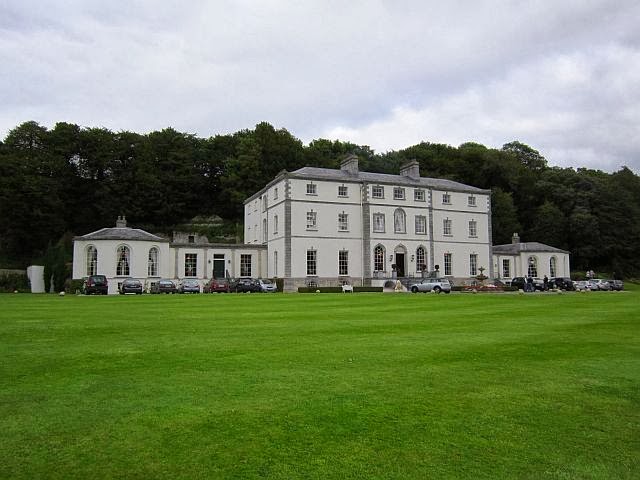
Our first stop was Rockrohan House, the impressive home of Richard Wood.  Set in a beautiful parkland, the Italianate House was added to an earlier eighteenth century house.  It has an attractive single storey porch and a canted bay to one side.  We enjoyed cream teas and coffee in the wonderful ambience of Rockrohan's dining room.  Richard provided an informed description of his romantic Irish landscapes that adorn the walls.  Following this, he produced two montage pencil sketches of Cork's landmark building which challenged our knowledge of local heritage structures.  Our Georgian element ended here as the theme changed to a more industrial nature.

Inniscarra hydro-electric power station is one of two dams constructed in the 1950s to harness the water of the River Lee for electrical power, the other being Carrigadrohid.  It involved the creation of two lakes in the picturesque Lee Valley.  Here we were welcomed by our guides Rebecca and Colm.  Having viewed an education film, we entered the control room.  The workings of the generators and the important business of water level control, by sluice-type spillway gates, were explained by the operators and there was no shortage of questions by our learned group!  The dam is of the buttress type and the sheer drop of 42 metres was experienced by viewing it from the bridge.  A stunning view of the lake on the other side was observed.  The fish pass and hatchery operations were explained at this point by our informed guides.  Surprisingly, a family of otters was spotted in the waters below ... not so unusual according to guides Colm and Rebecca.

Toon's Bridge Cafe provided an appetising lunch.  Here, Jenny-Rose put on an array of antipasti starters, tasty chorizo stew, a delicious chocolate raspberry brownie and excellent coffee.  As a result there was a rush to pick up some goodies to bring home from the dairy shop next door.  We then departed for Bealick Mill.

Bealick Mill was constructed by the Harding family in 1797 and benefitted greatly from the Napoleonic wars.  Following a period of decline and disuse, it came into its own as a 'heritage centre',  It has seen many uses in its day and our guide, John carroll, recounted how it had supplied street lighting for Macroom while London was still relying on gas lights.  Furthermore, Charlie Bird's ancestor was the engineer responsible!  Originally a corn grinding mill, it was later used for Macroom oatmeal production.  Having seen many years of dereliction, today the mill house stands respendently restored while its wheel once again turns to the force of the Larney River.

Georgian splendour, the best local food and hydro-electric power on the River Lee were pleasantly exhilarating!


A Lecture by Patrick Guinness at Fota House in March, 2013

The Cork Chapter of the Irish Georgian Society was delighted to welcome the president of the society, Patrick Guinness, to present a lecture "How my parents Desmond and Mariga influenced me".  Patrick was appointed the third president of the Irish Georgian Society in 2012.

The group enjoyed lunch which was followed by a tour of Fota by Geraldine O'Riordan who delighted the attendees on the day with her great knowledge of the house and its art works.  Prior to the talk given by Patrick, Alicia St Leger and Kevin Hurley presented a short ten year review of visits and events.

Patrick's talk was enjoyed by all.  He talked about the early days of the society when his parents Desmond and his late mother Mariga were involved in so many different aspects of fund raising and generating publicity for the good work of the society.


Irish Architectural and Decorative Studies Journal Launch in Cork 2013

On 26th January 2013 the Cork Chapter hosted the launch of the Journal of the Irish Georgian Society.  The event began with lunch at Isaac’s Restaurant in MacCurtain Street, attended by fifty-five members, some of whom travelled long distances to be present.  Many of them bravely took part in a walking tour in very heavy rain!  Led by Dr. Alicia St. Leger, the group explored some of the varieties of architecture found in the city centre from the High Victorian streetscape of MacCurtain Street to the restrained Georgian architecture of North Mall and Grenville Place.  Crossing Washington Street provided an opportunity to look at a streetscape featured in an article by Louise Harrington in the journal.  Not far from there, the group looked up at the impressive ramparts of Elizabeth Fort, before reaching St. Fin Barre’s Cathedral.

Richard Wood was the guide at the cathedral and he provided a fascinating tour of the building, both outside and then in the welcome dryness of the interior.  He is renowned for his encyclopaedic knowledge of the building which he imparts with energy and enthusiasm.  The cathedral was consecrated in 1870 and was designed in every detail by the English architect, William Burges.

Richard Wood then launched Irish Architectural and Decorative Studies: the Journal of the Irish Georgian Society.  He recalled the many campaigns with which the society was involved over the years and commended the journal to one and all.  Refreshments were then served, co-ordinated by Maura Currivan and Geraldine O’Riordan.  Thanks to Kevin Hurley for all his work in connection with the event.


A Visit to The South Parish of Cork City

Members of the Cork Chapter braved cold conditions to tour buildings in the South Parish of Cork city on 24th November 2012.  The group, led by Dr. Alicia St. Leger, met at the Anglesea Road side of Cork City Hall, built in 1936  to the design of the Dublin architectural firm of Jones and Kelly.  Just across the road is the distinctive former Model School, designed by James Owen and first opened in 1865.  It was divided into boys, girls and infants divisions.  It also had a maritime school and the campanile was used to observe shipping in the harbour.  It was recently restored and is now Cork District Court House.

The group then walked to Newenham Terrace, noting en route the attractive architecture of Saint Joachim and Anne’s Home, built in 1860 to the design of Cork architect Henry Hill.  Newenham Terrace was constructed about the same date and members were delighted to see the interior of a recently restored house in the terrace.  The house has been modernised using best conservation standards and a warm welcome was given to the group.

Back in the cold outdoors, the group next visited St. FinBarr’s South Chapel in Dunbar Street.  Known affectionately as the ‘South Chapel’, it was built in 1766 and is an interesting example of an early pre-Emancipation chapel.  The best known feature of the church today is the carving of the ‘Dead Christ’ by renowned sculptor John Hogan (1800-1858).  Hogan lived for a time in nearby Cove Street.  Not far away is the South Presentation Convent, founded in 1776, where the group was given a fascinating tour of the buildings by Sr. Rosario.  The convent on Douglas Street is where Nano Nagle began her schools for the education of the poor and she is buried in the nuns’ graveyard there.

The tour concluded at the Religious Society of Friends (Quakers) Meeting House, built in 1938 to the design of William Henry Hill.  The simple building replaced an earlier meeting house on Grattan Street in the city centre.  Members of the group received wonderful hospitality at the Meeting House and enjoyed good food prepared by Myrtle Allen and Geraldine O’Riordan.


Tuesday, October 29, 2013

A Visit to Castle Hyde, Fermoy

It is rare for the Cork Chapter to allocate a whole afternoon to visit one estate but Castle Hyde, the County Cork home of Michael Flatley and his wife Niamh, merited extra special focus and attention for our September outing.

The logistics of the visit were carefully planned and executed so that large number of vehicles were efficiently parked and the group quickly gathered on the steps of the entrance to the magnificent 18th century Palladian Castle that overlooks the tranquil waters of the River Blackwater.

We were graciously welcomed by Vivienne O'Grady and led into the fabulously restored wide 'gallery' hallway.  There, the architectural historian, Jeremy Williams, kindly acquiesced to conduct a tour of the house in two phases.

The separate staircase hallway, that houses a fine stone cantilever staircase, was accessed via the centre of the main hallway.  Visitors gazed upwards in awe at the splendour and beauty of this oval shaped masterpiece rising the full height of the house.

There is so much to appreciate and admire at Castle Hyde but what stood out for us on that memorable afternoon, was the pleasure of being able to walk the length of the entire house from one pavilion to the other, located as they are, at the eastern and western ends of the house.  Numerous reception rooms, with their priceless fireplaces, enticed you to linger along the way, but the lavish decoration of the dining room restoration and the opulence of the three storey library, all but took one's breath away.

Having made our way outdoors eventually, the fine early autumn air of the woodlands and gardens, was the perfect way to work up an appetite to further partake of our famous host's hospitality.  Back at the mansion, a truly unique and much enjoyed visit was rounded off by afternoon tea presided over by Vivienne O'Grady.

Our grateful appreciation to Niamh and Michael Flatley for welcoming the Chapter to their Cork home.  Special thanks to PA, Vivienne O'Grady, Castle Hyde staff, Jeremy Williams and to our Chapter Chair who organised the entire event.


An Evening with The Friends of Fairfax House, York and The Cork Chapter

The Cork Chapter and the Friends of Fairfax House, York, jointly hosted a unique event at the Crawford Art Gallery, Cork, for members and friends in September 2012.  The splendid sculpture gallery that houses the fine Canova castings of the Greco-Roman period, together with the magnificent Neo-Classical sculpture casts of the nineteenth and twentieth century periods, set the tone for a sparkling reception between the York and Cork friends.

Crawford Gallery Director, Peter Murray, delighted visitors with his talk on the works of art that surrounded his audience, while the Corkonians present quietly glowed with pride in the midst of their fine artistic heritage.  Buff Reid, spokesman for the York friends, conveyed her appreciation of the warm Cork Chapter céad míle fáilte.  Buff also thanked the Chapter for the help and local knowledge extended to the group in the planning of the itinerary of the South of Ireland Tour of stately homes by The Friends of Fairfax House.

Linked by common interests, everyone quickly got to know each other as stories were swapped and experiences shared.  The reception concluded with a much anticipated private tour of the gallery.  The group was happy to linger and admire the extensive collection of work on view at the gallery.

The event was a spectacular success, budding friendships blossomed and new ones were established.  Firm commitments were made to strengthen links between the two countries.  The prospect of a return visit to York by the Cork Friends remains as a possibility in the not-too-distant future.


Wednesday, August 29, 2012


A Celebration of John Roberts


The Waterford classical legacy of architect John Roberts, presented the Cork Chapter members and friends with an excellent motive to reserve Sunday 17th June for a day out together. The day, by any standards, was truly a memorable one for many reasons, not least of which was the fact that the day was one of the rare sunny days this summmer. The carefully chosen programme was unique in that we were afforded the opportunity to explore and embrace several types of architectural gems designed by the same archiect, with one exception. These masterpieces comprised of Curraghmore House, Portlaw, The Bishop’s Palace and The Church of Ireland Cathedral, Waterford City, together with the exception of the Church of Ireland, Clonegam Church.

Being a Sunday, it seemed fitting that we should start with a visit to Clonegam Church, perched on a hill, within the Curraghmore Estate of the Marquess of Waterford in Portlaw. While the Church of Ireland Clonegam church was not designed by Roberts, it is also a fine Georgian structure built in 1741 for Sir Marcus Beresford Earl of Tyrone and Countess Catherine de la Poer who had united the Beresford and de la Poer families with their marriage.

The group was captivated by the range of funerary monuments and deeply moved by the delicate white marble statue of a lady with her infant, created by Boehm in 1873, immortilising the memory of Lady Florence Grosvenor who died with her baby. The stillness of remembered dead was only briefly broken as our group forced themselves to leave the past and proceed with the present by moving outdoors to cast an eye over the magnificent Curraghmore House as it lay in the valley beneath, beckoning us in the morning sunlight.

Curraghmore House looked truly monumental as we approached its vast and splendid courtyard. We were awestruck by the combination of architectural features from several periods that lay before us, starting with its 1167 origin. Lord Waterford’s house guide Basil, warmly welcomed our group and he proved to be a knowledgeable, enthusiastic and patient guide. We learned that while this ancient structure was modernised by John Roberts of Waterford City in the eighteenth century, James Wyatt created a series of neo-classical decorated rooms that delighted our sensibilities.

More splendours awaited us outdoors, as we viewed the Victorian refacing to the front of the building and enjoyed the formal parterre and tiered lawns as we walked towards the renowned Shell House created by Catherine Countess of Tyrone in 1754. As we crowded into the dimly lit shell house, John van Nost’s statue of the Countess lit up the space with its pure beauty.

Later in the afternoon in Waterford city, and fortified after a delicious lunch, the group was led through the fine Georgian interior of The Bishop’s Palace designed by Roberts in 1746. We were captivated by beautifully proportioned rooms that were full of exquisite silver, fine portraits and the splendour of Waterford Crystal chandeliers, all set off by the exemplary restoration of the building by Waterford City Council.

Cheek-by-jowl to the Bishop’s Palace was the third Roberts designed building on our programme, the Church of Ireland Christ Church Cathedral, 1774. Members were stunned by the exterior elegance of its wonderful tower and classical proportions. Inside, we were enthralled by its fine Georgian interior that included glittering chandeliers, magnificent stained glass windows, restrained wooden pews, but especially by its newly Kenneth Jones restored organ. Members gathered spellbound as we were treated to a special performance by Eric Sweeney, the cathedral’s musical director. Our applause registered our appreciation as we realised that John Roberts cathedral is not only a place of worship but a place of art and culture also.

As our group ventured out onto the street once more in the late afternoon sunshine, we were still taking in the exterior splendour of the cluster of Roberts buildings that gives the City of Waterford its integrity.  Our special thanks to all our hosts and to Kevin Hurley and Catherine FitzMaurice for conceiving and planning an outstanding and integrated programme.