Thursday, July 1, 2010

Cork Chapter Visit to Castletownsend


The weather was stunning - warm sunshine and blue skies - yet it was only one aspect of a day that was perfect in so many ways! Cork Chapter members gathered at Shana Court, formerly the Custom House, in Castletownshend on Saturday 22nd May. There a warm welcome was received from the Orfeurs, who also provided refreshments. Tours of this fine 1745 house revealed many interesting features, particularly the Armada chairs.

A short stroll down the sunlit street was followed by a more strenuous climb up the 52 steps to St. Barrahane’s Church. It was well worth it! Not only was the view over the bay beautiful, but the church itself is a gem - and a well kept one at that. Inside are many historic memorials and items of interest, but our group paid particular attention to the Harry Clarke windows. Geraldine O’Riordan gave an excellent talk about Clarke and his artistic skills, helping us to appreciate the aesthetic and historical background to the St. Barrahane’s windows. Having viewed the graves of Edith Somerville and Violet Ross, members of the group strolled through the graveyard and down to sea level to visit Castle Townshend.

Rosemary Cochrane-Townshend welcomed the group and showed members around this historic house, the oldest part dating from about 1650. The long association with the Townshends was seen in the portraits and many other items which were linked to previous generations of the family. Although the temptation was to linger at the castle with its wonderful views over the bay, lunch beckoned at Mary Ann’s Restaurant. So it was back up the hill to the shaded outdoor eating area where a tasty lunch was enjoyed by all.

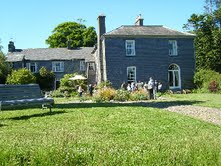
Our final destination was not too far away, just up the road to Drishane House. This attractive weather-slated house was built in the late eighteenth century by Thomas Somerville and our members were welcomed by the current owners, Tom Somerville and his family. A tour of the house, with its many beautiful features, was followed by a visit to the nearby little museum which contains images and artefacts relating to author Edith Somerville who lived at Drishane. Even her little dog was preserved! Then it was time to explore the grounds surrounding the house with their mix of lawns, orchard and shady woods, all set on the hillside overlooking the sea. It was heaven! Refreshments kindly provided by the Somervilles were the perfect ending to the perfect day!

Thanks to Maura Currivan who organised the visit and to the welcoming hosts who made the Cork Chapter visit to Castletownshend such a success.

Tuesday, June 29, 2010

A MIDSUMMER VISIT TO NORTH CORK

Irish Georgian Society
Conserving Ireland’s Architectural Heritage

Blog: igscork.blogspot.com

CORK CHAPTER

Patron: Mrs. Myrtle Allen

A MIDSUMMER VISIT TO

ST. COLMAN’S Church of Ireland, FARAHY
The site of the demolished BOWEN’S COURT
BALLYMACMOY HOUSE &
ANNES GROVE HOUSE & GARDEN

Saturday, 17th July, 2010 @ 10.45am

10.45am Meet at St. Colman’s Church of Ireland Church, Farahy for registration etc.
11.15am Tour of St. Colman’s followed by visit to site of the demolished Bowen’s Court
1.00pm Lunch at Ballymacmoy House followed by a tour of the house, courtesy of Mr. Frederic Hennessy
3.00pm Tour of Annes Grove House & Garden, followed by refreshments, courtesy of Mrs. Jane Annesley

St. Colman's Church, Farahy is noteworthy for its association with the author Elizabeth Bowen (1899-1973), who lived at Bowen's Court and is buried in the churchyard. The church was built in 1721 and is a fine example of a very rare early 18th century Church of Ireland church. Attached to it is an early 18th century schoolhouse that is now used as the vestry.

Bowen’s Court was a classic example of the tall and square 18th century Irish house and was built by Henry Bowen to the designs of Isaac Rothery in 1776. The house was three storeys over a basement and had a seven bay entrance façade with a three bay breakfront and a pedimented door case. The house was the home of Elizabeth Bowen (1899 – 1973) the novelist and it has been immortalised in her book ‘Bowen’s Court’ with its “rows of dark windows set in the light façade against dark trees has the startling, meaning and abstract clearness of a house in a print, a house in which something important occurred once, and seems. from all evidence, to be occurring still”. Due to rising costs the house had to be sold in 1959 and it was demolished in 1961 by its new owner.

Ballymacmoy House is a Regency house built in 1818. It is the original home of the Wild Geese family - the Hennessys of Cognac. The compact estate is located at the edge of the village of Killavullen. It has three and a half miles of exclusive fishing rights along the river Blackwater and has a one acre walled garden. There is also a unique prehistoric private cave on the estate.

Annes Grove House was built in the early eighteenth century. In 1900 Richard Grove Annesley (1879-1966) inherited the property and developed the renowned Robinsonian gardens. After his death in 1966, the task of maintaining the gardens fell upon his son, the late E. P. Grove Annesley, and they are now being conserved by his grandson, Patrick Grove Annesley. The ‘Woodward’ gate lodge has been restored by the Irish Landmark Trust.

Numbers are limited so advance booking is essential. Tickets cost €30 (members) €40 (non-members) including lunch and must be purchased in advance by completing the application form below. N.B. Full details: name, address, contact details & membership no. etc., of each person attending the tour must be provided.

Terms & Conditions: Participation at the discretion of the committee. No bookings accepted without payment. Attendees must provide own transport.

Enquiries to Geraldine O’Riordan. (Tel: 087-2755764 or email: geraldineoriordan@yahoo.ie)

Saturday, May 8, 2010

AN EXCEPT FROM THE SPRING NEWSLETTER VOL. 2 2010

The colonnade at Russborough House, Co. Wicklow features on the cover of the Newsletter Vol. 2 Spring 2010.

The newsletter contains a number of interesting articles with excerpts from some following:

President’s Letter: Desmond Fitzgerald, Knight of Glin

The effects of the global economic downturn and the effect on the society is addressed in the President’s Letter, Desmond Fitzgerald, Knight of Glin states ‘The coming year will be trying for the Society as the full effects of the crunch will be felt and many aspects of our organisation will be affected. Sadly we have had to let AOIFE KAVANAGH, our Projects Administrator, go which will be a great loss as she has been key to the Society in many areas but particularly in the development of our website and of our new newsletter. We will certainly find ourselves worse off with her absence and are endeavouring to secure funding to consolidate the Society’s other activities. Any help at all in this would be hugely welcome, so please get in touch with our office in Dublin if you can be off assistance'.


News from Russborough: William Laffan

WMF Watch List recognises threat to Co. Wicklow Demesne.
Often described as ‘the most beautiful house in Ireland’, Russborough, in the care of the Alfred Beit Foundation, is emerging as a model of how an Irish demesne can adapt to reinvent itself. Over the last few years a wide variety of events and activities has brought the estate to life. However, the fragile state of its parkland has been a concern to the Beit Foundation, which has successful campaigned to have Russborough listed on the World Monuments Fund (WMF) Watch List.


IGS Architectural Conservation Award: Robert O’Byrne

The Irish Georgian Society is delighted to announce the introduction of a significant new awards scheme for architects involved in the conservation of the country’s historic buildings. Intended to promote greater appreciation of Ireland’s built heritage, the awards, the award’s first winners will be announced at a ceremony in late September. There will be two award categories, one for a conservation project and one for a non-CAD (computer aided design) drawing relating to a historic building. Applications for the awards must be received by the Society on or before July 31st next.
Further details and information on applications can be found on the Society’s website.


The Importance of Maintenance: Emmeline Henderson

A Stitch in Time saves Nine: The Importance of Maintenance
As the adages go ‘a stitch in time saves nine’ and ‘prevention is better than cure’. The same holds true for our historic houses, where regular inspection, maintenance and repair can safeguard their condition. Failure to identify problems early can produce major faults which may not be only very costly to rectify but may potentially cause the irreplaceable loss of our buildings’ historic fabric. So what should one consider when conducting maintenance inspection works?


Architectural Moments in the History of Limerick City: Judith Hill

If you live in Limerick, the city is big enough, busy enough, complex enough to fill your horizon to the extents that it is a shock how quickly, rising above it in an airplane, it resolves into a definable shape, a finite settlement in the landscape. It is a small city, but it has the diversity and functions and, despite its size, the scale of a city.


Planning Issues: Donough Cahill

Donaghcomper, Celbridge, Co. Kildare

In Celbridge, permission has been granted by Kildare County Council for new roads and service works in Donaghcomper demesne; development proposals that are in addition to those currently being considered by An Bord Pleanála. These new infrastructural works are intended to facilitate the future development of Celbridge town to include new commercial and residential buildings. Whilst the society will be appealing the decision, should the large scale development works go ahead in the future, they would have a devastating impact on the character of Castletown, Celbridge town and on vistas from Kildrought House which has been restored to such an exemplary standard in recent years.


Events Round Up: Aoife Kavanagh

A review of events organised by Dublin and the various chapters including our own Cork Chapter featuring the West Cork trip, Collins Barracks and Ennismore House, and the Christmas Party.

Tuesday, April 27, 2010

LISMORE AND SALTERBRIDGE SATURDAY 24TH APRIL 2010 EVENT REPORT


THE TOWERS, BALLYSAGGARTMORE; BALLYIN GARDENS;
ST. CARTHAGE’S Church of Ireland CATHEDRAL; O'BRIEN CHOP HOUSE LISMORE;
SALTERBRIDGE HOUSE & GARDEN

Saturday, 24th April, 2010

Ballysaggartmore was the beginning of a packed itinerary with a visit to ‘The Towers’ just outside Lismore. The dull and grey sky yielded to bright blue just as we reached the gate lodges on our circuit. We enjoyed a leisurely stroll through the forest peppered with snippets of information on the dry bridge, the castellated bridge and a pair of identical gate-lodges which have survived to this day to amaze us all. Mr. Kiely was reviled as a landlord but his creations have outlived his appalling treatment of his tenants and the local community is to be commended for revealing such treasures where the norm would have seen them demolished and the stone-work used for road building.

A sharp right turn on the road brought us into the secret world of ‘Ballyin Gardens’ and we were educated as to the origin of the gardens and the treasures within by the owner of the gardens Mr. Peter Raven. This was an extra attraction on our programme and it certainly did not disappoint. With wonderful views over the river Blackwater and planting to match the wonderful scenery our brief visit was brought to a conclusion by the needs of the clock and our timetable. Another visit beckons sometime in the future when time is not at a premium.

St. Carthage’s Cathedral was brought to life with a wonderful historical description by Dermot Edwards who has an encyclopaedic knowledge of the cathedral from its founding to its present incarnation. We learned that many of Ireland’s famous architects worked here including Sir William Robinson (who designed the Royal Hospital Kilmainham); Sir Richard Morrison rebuilt the cathedral and James & George Richard Pain designed the tower and spire. We also visited the little known library with its fine collection of volumes amassed over the years. We are very grateful to the Very Revd. Paul Draper, Dean of Lismore for the warm welcome and the refreshments that were much appreciated.

We had to be torn away from the cathedral for our lunch appointment but it was well worth it. Having enjoyed a restorative lunch and dessert at O’Brien Chop House we set off for our final destination with the grey clouds beginning to appear.

We journeyed down to Salterbridge House past the newly restored gate-lodge that has been resurrected from dereliction by the Irish Landmark Trust and available to anyone who wishes to stay in such an unusual and attractive lodge. Venturing up the avenue we were welcomed by Philip and Susie Wingfield who gave us a short history of the house and its evolution over the years. We toured the out-buildings, the gardens before arriving indoors for a tour of the ground floor reception rooms and the bedroom corridor upstairs including ‘the coldest room in Ireland’ as Philip explained. Having toured the house and grounds we were treated to a welcome cup of tea accompanied by home made scones with jam. All too soon it was time to leave Salterbridge, thank our hosts and thus brought our very enjoyable and varied day to a close. Thanks to our committee for helping out on the day and to Kevin Hurley for organising the event.

Friday, April 16, 2010

A VISIT TO SOME HOUSES IN AND AROUND CLONMEL

Irish Georgian Society
Conserving Ireland’s Architectural Heritage

Blog: igscork.blogspot.com

CORK CHAPTER

Patron: Mrs. Myrtle Allen

A VISIT TO SOME HOUSES IN AND AROUND CLONMEL

MARLFIELD HOUSE, NEWTOWN ANNER HOUSE
& GURTEEN LE POER CASTLE

Saturday, 19th June, 2010 @ 09.30am

09.30am Meet at Marlfield House, Clonmel for Registration etc.
10.00am Tour of Marlfield House kindness of Denis English
11.30am Tour of Newtown Anner House and Grounds, Clonmel kindness of Nigel N. Cathcart
1.00pm Lunch at Befani's restaurant & The Main Guard, Sarsfield Street, Clonmel
2.30pm Depart for Gurteen Castle, Kilsheelan, Co. Waterford
3.00pm Tour of Gurteen Le Poer Castle kindness of Gottfried & Renate Helnwein
4.30pm Knocklofty House Hotel, Clonmel for refreshments (at own expense)

Marlfield is located just south of the old Cork to Clonmel road (between Ardfinnan and Clonmel) and is a striking feature on the landscape. Designed to the classical layout of Palladianism this house exhibits many notable features which contribute to its architectural significance. Burnt in 1923 by rebel forces, the main house was rebuilt in 1925, creating an excellent reproduction of late-eighteenth century features such as the timber sash windows. The impressive conservatory is a fine example of the work of Turner, with its ornate curving arches and radiating fanlights. The blind niches to the quadrants and the façades of the pavilions, with their entablatures and urns, display direct influences from Classical architecture, enlivening the appearance of the building. The grandeur of the house is further enhanced by the related outbuildings, fernery, garden entrance and tunnel, all contributing to the setting of the house. (N.I.A.H. Buildings of Ireland – Tipperary SR rec. no. 22112003)

Newtown Anner House (beyond Bulmer’s Plant) was formerly the home of the Duke of St Albans and the Osborne family, this imposing substantially intact country house preserves a skilfully and delicately carved doorway which gives the house an ornate focus. The house is notable for its wings which, unusually, are taller than the central block. The vertical thrust of the wings is emphasised by the diminishing windows. The setting is enhanced by the shell grotto, the well-preserved walled garden and the ruined temple, all of which add context and are fine examples of the activities of this significant former demesne. Now it’s the home of Mr. Nigel N. Cathcart who is restoring the building as funds permit. (N.I.A.H. Buildings of Ireland – Tipperary SR rec. no. 22207718)

Befani’s Mediterranean & Tapas Rrestaurant is run by Business Partners & Friends Adrian Ryan & Fulvio Bonfiglio. Adrian is our Head Chef, while Fulvio manages the restaurant. With their combined years of experience and knowledge of food they constantly strive to provide you with a varied and interesting menu, which is prepared using fresh, seasonal vegetables and organic produce when available.

The Main Guard which was built in 1675 as the courthouse and was converted into shops circa 1810. It has been recently restored to its original form with a loggia of open arches and the sandstone columns are once again a feature of the streetscape. (This visitor attraction is run by the OPW and can be visited free of charge)

Gurteen Castle is a monumental Elizabethan Revival house of national importance, which retains its original form and massing together with important salient features and materials, both to the exterior and to the interior. Built to designs prepared by Samuel Ussher Roberts (1813 - 1892) for Edmond, first Count de la Poer (n. d.), the architectural quality of the house is enhanced by the complex arrangement of gables, towers and turrets, all of which enliven the skyline. The construction in limestone ashlar attests to high quality stone work, which is particularly evident in the fine detailing throughout. A group of gateways to the grounds enhances the artistic design quality of the site, while a garden turret contributes to ornamental quality of the battlemented enclosure, itself augmenting the medieval tone of the grounds. The house is of additional importance in the locality on account of its associations with the de la Poer family. The house is now the Irish home of Gottfried and Renate Helnwein. (N.I.A.H. Buildings of Ireland - Waterford rec. no. 22900208) (www.gottfriedhelnwein.ie)

Knocklfoty House (Hotel) is a former country house served as the seat of the Donoughmores until the mid-1980s. The architectural design draws on the influences of classical architecture in its detailing. This is exhibited in its ornate entrance front, which is adorned with features such as the broken pediments, Doric pilasters, wreathes and busts. The retention of features such as the timber sash windows enhance the buildings appearance, while the dome roof over the central door case is a striking feature which adds further to the architectural significance of the building. This former country house forms part of an interesting group of demesne related structures with the servants quarters, outbuildings, gate lodges, estate workers' houses and bridge. (N.I.A.H. Buildings of Ireland – Tipperary SR rec. no. 22208216) (www.knockloftyhousehotel.com)

Numbers are limited so advance booking is essential. Tickets cost €50 (members) €60 (non-members) including lunch and must be purchased in advance by completing the application form below.

N.B. Full details: name, address, contact details & membership no. etc., of all persons attending the tour must be provided.

Terms & Conditions: No attendance without pre-booking. Participation at the discretion of the committee. No bookings accepted without payment. Attendees must provide own transport.


Enquiries to corkigs@gmail.com or Mobile: 087-9266826

A VISIT TO CASTLETOWNSHEND - THE SOMERVILLE & ROSS TOUR

Irish Georgian Society

Conserving Ireland’s Architectural Heritage

Blog: igscork.blogspot.com

CORK CHAPTER

Patron: Mrs. Myrtle Allen

A VISIT TO CASTLETOWNSHEND
(THE SOMERVILLE & ROSS TOUR)

THE CUSTOM HOUSE, ST. BARRAHANE’S Church of Ireland
CASTLE TOWNSHEND & DRISHANE HOUSE

Saturday, 22nd May, 2010 @ 10.00am

10.00am Meet at Shana Court formerly the Custom House for registration etc.
10.30am Tour of Shana Court, followed by refreshments courtesy of Mrs. Geraldine Orfeur
11.15am Tour of St. Barrahane’s Church, courtesy of the Churchwarden, Mr. Robert Salter-Townshend
12.15pm Tour of Castle Townshend and grounds, courtesy of Mrs. Anne Cochrane-Townshend
1.15pm Lunch at Mary Ann’s Bar & Restaurant
2.30pm Tour of Drishane House, followed by refreshments, courtesy of Mr. Tom Somerville

The Custom House is a fine Georgian building dating from 1745 retaining many original features. It is now known as ‘Shana Court’ and is available for short-term lettings.

St. Barrahane’s Church of Ireland dates from 1826 and was built with stone brought from Horse Island. It contains three ‘Harry Clarke’ windows and is intimately associated with Edith Somerville & Violet Martin of Somerville & Ross fame who are buried in the adjoining church yard.

Castle Townshend has been the seat of the Townshend family for generations with the oldest part dating from circa 1650. The towers of the present castle were constructed from the remains of the ruined castle. The Cochrane-Townshend descends from the original Townshend family.

Mary Ann’s Bar & Restaurant is a quaint old fashioned Irish Pub that is one of the finest gourmet restaurants in Ireland. It has three Egon Ronay awards to show for it! Relatively unchanged in 150 years, retaining the old fashioned feel of the place. The bar is fully stocked with draught and bottled beers and spirits. Our large wine list encompasses wine regions throughout the World. Fergus and Trish O’Mahony have always believed in trading locally. The majority of suppliers are based within a five to ten mile radius of Mary Ann's, who only buy the best of Irish produce.

Drishane House is described as “A two storey house of 1849 built onto the front of an earlier house extending round three sides of a courtyard, enclosed on the fourth by a screen wall with an arch”. It was the family home of Edith Somerville. (Mark Bence-Jones, A Guide to Irish Country Houses © 1988)

Numbers are limited so advance booking is essential. Tickets cost €50 (members) €60 (non-members) including lunch and must be purchased in advance by completing the application form below. N.B. Full details: name, address, contact details & membership no. etc., of all persons attending the tour must be provided.

Terms & Conditions: No attendance without pre-booking. The committee reserve the right to refuse admission to any event. No bookings accepted without payment. Attendees must provide own transport

Enquiries to corkigs@gmail.com or Mobile: 087-9266826

Thursday, March 18, 2010

VOLUME XII OF THE IRISH ARCHITECTURAL AND DECORATIVE STUDIES JOURNAL 2009

Foreword by The Knight of Glin

This, the twelfth volume of the Irish Architectural and Decorative Studies, was launched at the No. 1 Pery Square hotel in Limerick, next door to the Georgian house preserved by the Limerick Civic Trust. In this context, it is sad to note the recent death of Denis Leonard who did so much to save this fine example of domestic architecture, and, indeed, so much else in the city of Limerick. His enthusiasm and commitment will be long remembered.

As usual, there is great variety to the contents of the Journal, which reflects its deliberately wide scope, from architecture, painting, sculpture and the decorative arts to patronage, travel and history of demesnes. As often, one of the themes running through the articles is, perhaps surprisingly, a fluid tale of migration – of individuals, styles and motifs. We have the sad story of a Mayo artist and an American poet on Capri, the monument in Florence to the Italian architect of Castletown; the French goldsmiths of Dublin, and the influence of the antiquities of Asia Minor and Iberia on Ireland. Highly appropriate, given our launch in the city, is the piece by Judith Hill on Plassey House just outside Limerick, which commemorates and Indian battle and is now owned by the University of Limerick.

This is the last of the issues to be edited by William Laffan, to whom I, and the Society, are very much indebted. I am very pleased to announce that Conor Lucey has agreed to take over as editor. Dr. Lucey, who lectures at University College Dublin and at National College of Art & Design, was awarded the Desmond Guinness scholarship in 2005, and has already served on the editorial board of the Journal. His study of Michael Stapleton, published by the Churchill House Press, was acclaimed by my old friend John Harris – praise indeed! Dr. Lucey is founding editor of the new journal Artefact, as is contributing to the new Art and Architecture of Ireland, Vol. IV (Royal Irish Academey) as well as other forthcoming publications. We are delighted that a young scholar of his calibre has agreed to take over the reins.

Several forthcoming publications and events might be flagged, in particular two collections of essays. One, The Eighteenth Century Dublin Town House, is edited by Christine Casey, who is organising a seminar on stuccowork in Trinity College Dublin in April 2010. In addition, Lynda Mulvin is editing a volume on neoclassicism, which will be of great interest to members of the society. In early summer, the remarkable photographs by Patrick Prendergast of Irish country house interiors will be on show at the Irish Architectural Archive in Merrion Square. Twenty years ago, at the behest of Lord Belmore, Prendergast travelled around Ireland photographing houses still in the possession of the families of the builders. This resulted in an archive of some 2,000 intimate ‘behind the scenes’ shots of the Irish Big House, a selection of which will be on show. Having seen these photographs, I know that they will be a revelation to all those interested in the topic.

In difficult economic times, which the Society feels acutely, it is pleasing to welcome the happy diversion that the erudite contents of this Journal offer. However, the scholarship that the Journal embodies also has a very serious purpose which goes to the heart of the Society. The understanding of Ireland’s past is manifested in her art, architecture and material culture must permeate our activities and inform our decision making processes. Despite its manifest importance, it is proving increasingly difficult to attract funding for this Journal, though I am extremely grateful to the Esmé Mitchell Trust and the late Sir Alfred Beit’s Apollo Foundation for very welcome grants. I ask that members and supporters to all that you can to help this invaluable publication by subscribing and encouraging others to do so.

Contents:

Frederick O’Dwyer:- Robert West, Christopher Myers and St. James’s church, Whitehaven

Philip McEvansoneya:- New Light on he artistic and personal aspects of the second version of ‘The Last Circuit of the Pilgrims at Clonmacnoise’ by George Petrie

Livia Hurley:- Wiliam Burton Conyngham’s antiquarian tour of the Iberian Peninsula, 1883-84

Terence Dooley:- Castle Hyde and the Great Famine, 1845-51

Brendan Rooney:- The painter and the poet: Michael George Brennan (1839-71) and Laura Catherine Redden (1839-1923)

Judith Hill:- The several incarnations of Plassey: Plassey House, University of Limerick

Lynda Mulvin:- Charles Robert Cockrell’s encounter with Ireland: drawings, observations and buildings

Jessica Cunningham:- Dublin’s Hugenot goldsmiths, 1690-1750: assimilation and divergence

Tom Dunne:- Sensibility and the sublime in the storm paintings of Thomas Roberts (1748-77)

Michael McCarthy:- The monument to Alessandro Galilei in S. Croce in Florence, 1737